
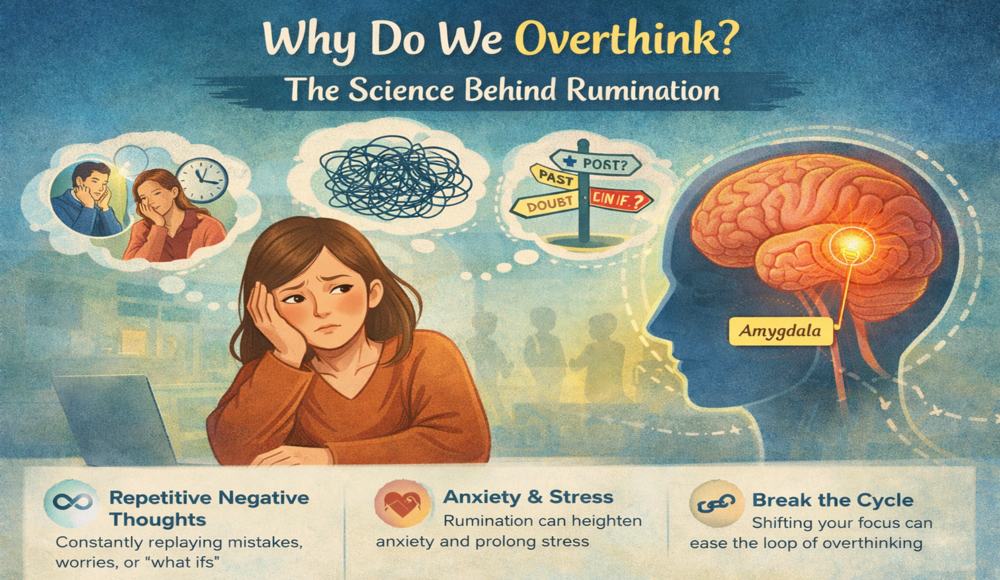
Have you ever replayed a conversation in your head for hours, wondering if you said the wrong thing? Or stayed awake at night analyzing a decision you already made? If you’ve caught yourself thinking, why do I overthink everything? — you’re not alone. Many people who seek an online psychologist consultation India mention this exact struggle: a mind that simply won’t switch off.
But overthinking isn’t just “thinking too much.” There’s real science behind it. In psychology, it’s closely connected to something called rumination. Let’s explore what’s actually happening in the brain — and what can help.
Overthinking Meaning: What Are We Really Talking About?
When people search for overthinking meaning, they’re usually trying to understand why their thoughts feel repetitive, intrusive, or exhausting.
Overthinking generally refers to repeatedly analyzing situations, conversations, or worries without reaching a clear solution. It often feels productive — like you’re “figuring something out.” But instead of clarity, it usually leads to more doubt.
Psychologists often connect this pattern to rumination psychology, which describes a mental loop where someone repeatedly focuses on distress, mistakes, or perceived problems. According to the American Psychological Association, rumination involves continuously thinking about the causes and consequences of negative emotions rather than taking action to address them.
In simpler terms?
It’s like pressing replay on a moment you wish had gone differently — again and again.
What Is Rumination in Psychology?
In rumination psychology, rumination is defined as repetitive, passive focus on distress and its possible causes. It’s common in anxiety and depression, but it can show up even in people without a clinical diagnosis.
For example
- You make a small mistake at work.
- You think about it all evening.
- You imagine your boss judging you.
- You question your competence.
- You replay the event before bed.
Nothing new is solved. But your stress levels rise.
Research from the National Institute of Mental Health shows that repetitive negative thinking patterns are strongly linked with mood and anxiety disorders. That doesn’t mean overthinking automatically equals a disorder — but persistent rumination can increase emotional distress over time.
Why Do I Overthink? The Brain’s Perspective
If you’ve ever asked yourself, why do I overthink even small things? — the answer isn’t “because you’re weak” or “too sensitive.”
Overthinking often develops as a protective mechanism.
1. The Brain’s Threat System
Our brains are wired to detect danger. The amygdala — the brain’s alarm system — scans for potential threats. When uncertainty appears (like an awkward conversation or unclear feedback), the brain treats it as something to “solve.”
For some people, the thinking brain (prefrontal cortex) keeps trying to problem-solve long after the actual threat is gone.
It’s like a smoke alarm that keeps ringing even after you’ve burned toast.
2. Causes of Overthinking: Common Psychological Triggers
There are several evidence-based causes of overthinking
- Anxiety sensitivity
According to the World Health Organization, anxiety is one of the most common mental health challenges globally. People with higher baseline anxiety are more likely to mentally rehearse worst-case scenarios. - Perfectionism
If you equate mistakes with failure, your brain may constantly scan for “errors.” - Low tolerance for uncertainty
Some people feel deeply uncomfortable not knowing outcomes — so they think excessively to regain a sense of control. - Past experiences
If past mistakes led to negative consequences, the brain learns to “double-check everything.”
None of these mean something is “wrong” with you. They’re patterns — and patterns can change.
Overthinking Anxiety: Why the Two Feed Each Other
There’s a close relationship between overthinking anxiety and rumination.
Here’s how the cycle often works
- You feel anxious.
- You analyze why you feel anxious.
- You imagine future problems.
- Anxiety increases.
- You think even more.
The Mental Health America explains that persistent worry and repetitive negative thinking can intensify emotional distress rather than resolve it.
It’s exhausting — because your mind never gets a rest.
Is Overthinking Ever Useful?
Yes — in moderation.
Reflecting on mistakes helps us grow. Planning ahead reduces risk. Careful thinking is not the problem.
The difference lies in function.
Healthy reflection
- Leads to a decision
- Feels purposeful
- Eventually stops
Rumination
- Loops endlessly
- Increases distress
- Doesn’t produce solutions
If your thoughts feel stuck rather than helpful, that’s when support can make a difference.
How to Stop Overthinking (Without Forcing Your Brain to “Just Relax”)
Many people search for how to stop overthinking, hoping for a quick fix. Unfortunately, telling yourself to “stop thinking” usually backfires.
Instead, research-backed approaches focus on changing your relationship with thoughts.
1. Notice the Pattern
The first step is awareness.
Ask yourself: Am I problem-solving — or looping?
Labeling rumination gently (“I’m stuck in a loop”) can reduce its intensity.
2. Shift From “Why?” to “What Now?”
Rumination often sounds like
- “Why did I say that?”
- “Why am I like this?”
Try shifting to
- “What can I do differently next time?”
- “What’s within my control right now?”
That subtle shift activates solution-focused thinking instead of self-criticism.
3. Set a “Worry Window”
Some therapists recommend scheduling 15 minutes a day to write down worries. Outside that time, gently postpone repetitive thoughts.
It sounds simple — but giving your brain a boundary can reduce overthinking anxiety over time.
4. Cognitive Behavioral Therapy (CBT)
According to research summarized by the American Psychological Association, CBT helps people identify and challenge unhelpful thought patterns.
CBT doesn’t eliminate thoughts. It teaches you to question them
- Is this fact or assumption?
- Am I mind-reading?
- What evidence supports this fear?
Over time, the mental loop loosens.
When Should You Seek Help?
Occasional overthinking is human.
But consider speaking with a licensed mental health professional if
- Thoughts interfere with sleep
- You struggle to concentrate
- Anxiety feels constant
- You feel emotionally drained most days
Therapy provides structured tools — not judgment. And you don’t need to “wait until it’s severe” to ask for support.
This blog is for informational purposes only and does not replace professional advice. If you’re struggling, consider speaking with a licensed mental health professional.
FAQ’s
Final Thoughts
If you’ve been asking yourself, why do I overthink so much? — remember this
Overthinking is not a character flaw. It’s a learned mental habit rooted in your brain’s desire to protect you. The goal isn’t to silence your mind completely. It’s to teach it when to rest.
And that’s something that can be learned.
If your thoughts feel overwhelming, reaching out to a mental health professional can be a powerful next step. You don’t have to untangle the loops alone.
